
 Machine Learning is a significant subfield of Artificial Intelligence, and the most significant current AI trend for business strategy today. Machine learning has been in the making several decades and has recently graduated from computer science labs and specialized applications to become a serious technological trend that promises new capabilities to existing businesses and many exciting startups. The early success of machine learning in image understanding, language processing, and even self-driving cars has inspired the development of services, products, and educational programs designed to put advanced Machine Learning in the reach of every business. As highlighted in an introductory post on Artificial Intelligence, management consulting firm Forrester forecasts that businesses who exploit this technology will rule the insights game, and “steal $1.2 trillion per annum from their less informed peers by 2020”.1 Evaluation of machine learning technology and planning to use this transformative technology will soon become a necessity for businesses at all levels in all sectors.
A scramble is now underway among technology providers to provide you machine learning-enabled products, frameworks for developing your own custom ML solutions, and even the training you need to make savvy decisions for your business where this new technology is concerned. This post will be the first of two to introduce you to this technology trend and the current developments that impact your business planning. In this article we will define machine learning, look at example approaches and applications, current market analyses about the significance of all this, and the emerging resources that business strategists are using to help them make informed decisions. In part two we will survey a range of products and frameworks designed to enable you to put these technologies into use today.
The stakes
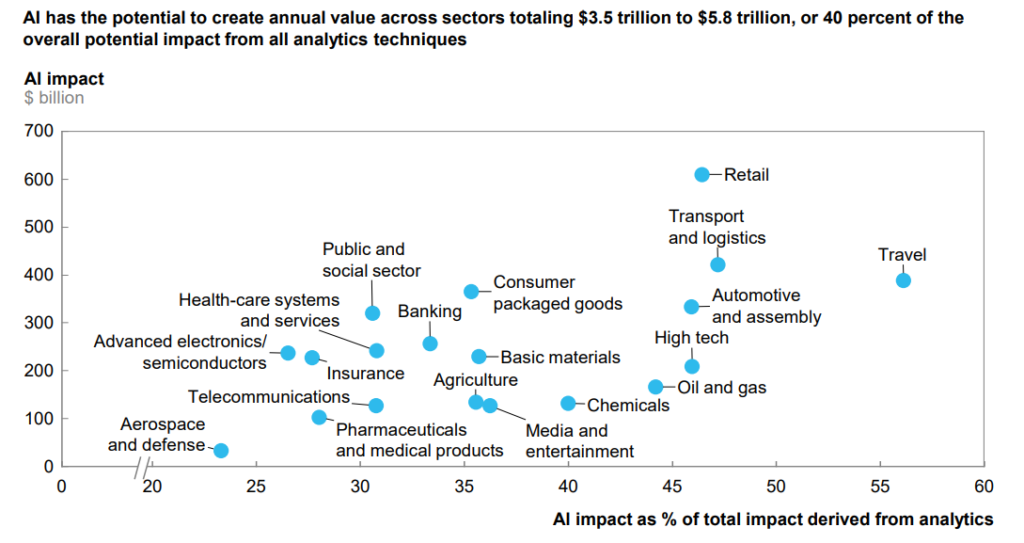
Machine learning has the potential to create between $3.5 trillion and $5.8 trillion in value annually across nine business functions in 19 industries. This impact will be realized both in top-line-oriented functions, such as in marketing and sales, and in operational functions, including supply chain management and manufacturing. This according to management consulting firm, the McKinsey Group.2
Getting to know Machine Learning
Given the impact this technology will have on business very soon, it is important to start with a basic definition and to distinguish between approaches. Machine learning refers to computer programs that can learn and make predictions on data. Such algorithms automatically construct models based on sample inputs, and subsequently those models are used to make predictions or decisions based on exposure to new circumstances (specifically, new data). Machine learning is best applied where designing and programming explicit algorithms cannot be done, and often when there is an abundance of data or other feedback available.3
Although there are a great many specialized implementations, most approaches in machine learning can be characterized as one of the following types:4
Supervised learning, in which a human labels the data used to train the model. Once the algorithm is exposed to enough training data that it finds appropriate connection between the input variables and the target output with enough accuracy, the algorithm is applied to new data. As an example, input data in a real estate application might use real estate listings as the input data. Your task would be to identify the appropriate features and label them appropriately (such as “time of year,” “interest rates,” etc.) and to train the model to predict your desired output variable (for example, predicted housing prices).
Unsupervised learning, in which an algorithm explores input data without being given an explicit output variable. In this operation, you do not label inputs with a target in mind, but simply expose the algorithm to your data. The algorithm discovers clusters of similar characteristics in the data on its own. For example, such a clustering algorithm might find in a large body of historical online sales data certain product preferences or price sensitivities associated with other customer behaviors on the site or demographic data, forming clusters of customers exhibiting similar buying behaviors.
Reinforcement Learning, in which an algorithm learns to perform a task simply by trying to maximize rewards it receives for its actions. In this design, the algorithm receives a reward if the action brings the machine a step closer to maximizing the total rewards available, and it optimizes for the best series of actions by correcting itself over time. For example, a reinforcement learning algorithm might seek the highest total return on an investment portfolio by making trades in that portfolio, each time measuring the points received for profitable trades and optimizing for maximum cumulative reward. This is most appropriate when you don’t have a lot of training data; you cannot clearly define the ideal end state; or the only way to learn about the environment is to interact with it.
Deep Learning is an especially effective variation of machine learning algorithm that mimics the structure and function of the brain with interconnected layers of software-based calculators, or “neurons” forming a “neural network”. These algorithms can ingest vast amounts of input data and process them through multiple layers that learn increasingly complex features of the data at each layer. These networks can process a wider range of data resources, requires less data preprocessing by humans, and can often produce more accurate results than traditional machine-learning approaches (although it requires a larger amount of data to do so). As an example deep learning is responsible for the remarkable accuracy seen in the facial recognition software that is now commonplace in our photo libraries.
Getting smart about Machine Learning
Knowing this landscape of machine learning algorithms and their potential applications is a huge step forward in properly evaluating the place for this technology in your business. The McKinsey aid, An Executive’s Guide to AI, presents a more thorough survey of the kinds of applications and use cases that are appropriate to each one of these techniques. There is a wealth of information available from such market research firms, industry analysts, and technology leaders.
A welcome new trend, for those charged with evaluating AI and machine learning projects, is a recent proliferation of new options for AI education aimed at non-computer scientist business owners. A notable example is the new self-paced, online course offered by MIT in partnership with the online learning platform GetSmarter, Artificial Intelligence: Implications for Business Strategy5. In contrast to the countless technical courses in AI and machine learning, this course is intended as a management course, oriented on providing attendees with executive overviews of machine learning, natural language processing, and other technologies, and equipping those participants to identify and evaluate potential AI implementations in their businesses.
The MIT option is designed to be somewhat exclusive, headlined by notable AI researchers and carrying a correspondingly high price-point. Happily, affordable offerings in the same topic are emerging on other platforms with variation in course focus and design. As of this writing, Coursera, another leading online learning platform (co-founded by a leading machine learning researcher) offers the course, Deep Learning for Business.6 In this course the instructors promise to teach what deep learning and machine learning is and how to use it for the advantage of your company. On the Udemy learning platform, the course, Innovation #3 Create New Business Models by Machine Learning7 promises to teach the basics of Machine Learning, again, with a primary focus on demonstrating to the business owner how to create business strategies around a particular platform. All of these offerings are worth a look and well worth the small time investment to become better-prepared for the AI revolution. Others are sure to emerge.
Now is the time to evaluate machine learning for your business
We can see in this mainstreaming of machine learning knowledge that this technology is making the move out of the lab and into business application. A great many business software offerings are beginning to include machine learning as a feature, and frameworks for development of custom solutions are emerging as major providers scramble for position. Part two of this article will survey that landscape. This is likely to develop and solidify in the coming few years.
Machine learning will transform nearly every business sector. By analogy — Amazon’s online everything-retail presence and rapid delivery performance transformed the retail sector’s fulfilment and inventory business models8, and is consequently shaping our service expectations in other aspects of life. In an even more profound way, the adoption of machine learning by large, leading businesses will redefine what it means to compete in every business sector imaginable. Industry leaders are moving aggressively — investing in research, identifying opportunities for machine learning to give them competitive edge and moving fast to be first to take advantage.
Part 2: Coming next week
- “Forrester Research, Predictions 2017: Artificial Intelligence Will Drive The Insights Revolution”, accessed 2/24/2018
- The McKinsey Group, Notes from the AI frontier: Applications and value of deep learning, accessed 4/24/2018; Figure from Discussion Paper: Notes from the AI frontier: Insights from hundreds of use cases
- Definition adapted from Wikipedia, https://simple.wikipedia.org/wiki/Machine_learning, accessed 4/29/2018.
- Definitions adapted from The McKinsey Group, An Executive’s Guide to AI, accessed 4/24/2018
- MIT Sloan Business School, https://executive.mit.edu/openenrollment/program/artificial-intelligence-implications-for-business-strategy-self-paced-online/#.WuZkHtMvxp8.
- Coursera, https://www.coursera.org/learn/deep-learning-business
- Udemy, https://www.udemy.com/creating-winning-business-models-based-on-machine-learning
- The Regan Group, “How Amazon is Changing Fulfillment and Inventory Management”, http://www.theregangroup.com/amazon-changing-fulfillment-inventory-management/, accessed 4/29/2018