
Business is experiencing an explosion in the availability of technologies collectively called artificial intelligence that promise to change the way we get insight from data, process human speech and written communications, and understand the content of images. We review recent survey results about what small businesses have to say about AI, ask a now-familiar “smart speaker” to help us define AI, and ultimately sketch out our own definition that will frame an ongoing investigation of AI for business.

Research firm Forrester predicts that we are in an “insights revolution” in which businesses of all sizes will scramble to adopt technology that will get them there. Importantly, the report suggests that businesses who exploit artificial intelligence (AI) will rule the insights game, and “steal $1.2 trillion per annum from their less informed peers by 2020” 1 . The report goes into some detail about how major players with analytics departments and chief data officers are moving aggressively to take advantage of big data, machine learning, and the coming internet of things.
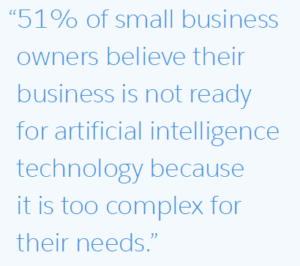
Not sure what those things are or might mean to your business? You are not alone. According to one recent survey of small businesses, most owners think they are not ready for artificial intelligence. 51% think AI is too complex for their needs, and 32% don’t know enough about how it can help their business.2
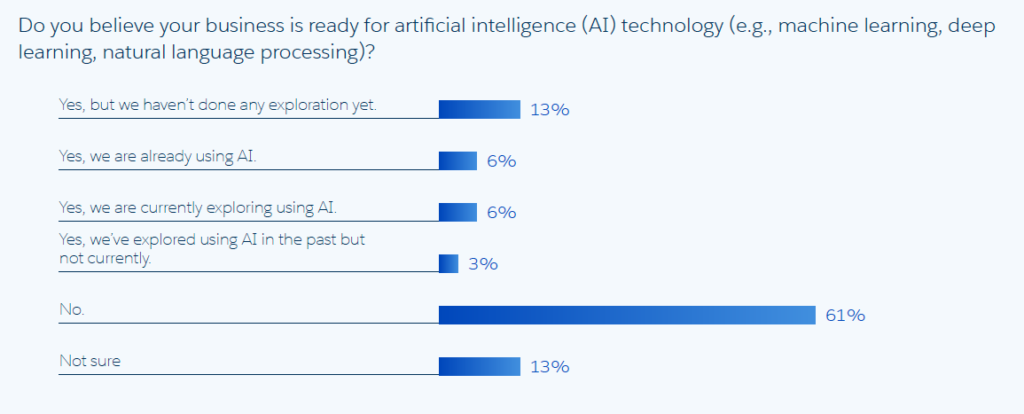
Yet 12% of those small business owners polled said they are using or exploring the use of AI in their business. What accounts for this? Have these businesses conquered the complexity? Or have they perhaps targeted some key area of performance with just the right solution from this smorgasbord of emerging technology, content to have found enough AI for their purpose?
This is where definition becomes important. And where AI is concerned already we are on tricky terrain. Researchers and developers in the field themselves define AI in ways that best describe their activities. You have to be careful, therefore, where you get your definition. I know, let’s ask Alexa!
Alexa, what is Artificial Intelligence?”
Well that was a bit circular and unhelpful. On to Wikipedia!
“Artificial intelligence (AI, also machine intelligence, MI) is intelligence demonstrated by machines, in contrast to the natural intelligence (NI) displayed by humans and other animals. In computer science AI research is defined as the study of ‘intelligent agents’: any device that perceives its environment and takes actions that maximize its chance of successfully achieving its goals. Colloquially, the term ‘artificial intelligence’ is applied when a machine mimics ‘cognitive’ functions that humans associate with other human minds, such as “learning” and ‘problem solving'”3
In this community-maintained definition, we immediately find that this is where Alexa looked up her answer. What made that answer so unsatisfying is that the agent fed to us a particularly uninformative introductory sentence of what is actually a pretty useful entry on AI. Peruse this page and you will discover the many facets of AI, including considerations of reasoning, knowledge, learning, communication, perception, and others. Wikipedia points out that what relates these seemingly separate pursuits under the umbrella goal of AI is that they are “functions associated with human minds”4.
But from a practical standpoint, few, if any, businesses are concerned with pursuing AI for the sake of mimicking human intelligence as a primary goal. For our purpose, let’s use as a working definition of “AI for business”, advanced technology that aids in the decision making and operations that we human business owners would ordinarily do ourselves or entrust to another human.
Under this definition we do not have to confine ourselves to today’s most prominent trends of chatbot customer engagement or deep learning over big data (although those things will be interesting to explore later). We can also include many well-established areas traditionally researched as AI including for example, optimization methods that solve classic business problems including vehicle routing, crew scheduling, resource allocation, cutting and partitioning solutions, and many others. Knowledge-based systems are widely used in business for systems that do diagnosis, tutoring, or troubleshooting.
Narrowly-defined AI is difficult for a small business to relate to. It is the proverbial hammer in search of a nail. And if I may wear the metaphor out a bit here, survey results cited above suggest that most small businesses are not so sure their problems look like nails–and besides, the hammers look awfully heavy! In this series and with our broad definition of AI for business, we can instead approach the broader tradition of AI like the toolbox that it is. Applying AI in your business depends first on studying your problems and opportunities. Only then will you choose a tool for both your needs and capabilities.
In coming installments, we will look at current trends, history, and applications of the tools that are most relevant to your business. Have something you think we should cover? Drop a comment below and let me know what we should explore.
References
- “Forrester Research, Predictions 2017: Artificial Intelligence Will Drive The Insights Revolution”, accessed 2/24/2018
- Stats and figures: Nationwide survey of small business owners commissioned online by Harris Poll on behalf of SalesForce, “Connected Small Business Report: See how small businesses use technology”, accessed 2/24/2018
- Wikipedia, https://en.wikipedia.org/wiki/Artificial_intelligence, accessed 1/24/2018
- ibid.